
A patient has just finished a course of dental implants costing £1,500. Another has completed a set of veneers priced at €1,500. Both are standing at reception, card in hand, ready to pay, at a practice registered with a body such as the General Dental Council in the UK. For most retail businesses, a transaction of that size would be unusual. For a dental practice, it can be an ordinary Tuesday afternoon.
Dental treatments often involve higher transaction values than many everyday businesses handle. That single difference changes what a practice needs from its payment setup. A card machine chosen for a small shop is not automatically the right fit for a clinic processing implants, orthodontics or cosmetic dentistry. This article looks at how dental practices, private dentists and dental groups across Europe and the UK can accept card payments efficiently, without drifting into unrelated topics such as clinic management software or merchant account onboarding requirements.
Card Machines for Dental Practices in Europe & the UK
A card machine for dentists needs to work for very different types of practice. An independent dentist running a single surgery has different needs to a multi-chair clinic with several practitioners, or a dental group operating across several towns or countries.
Card terminals are used daily by:
- Private dental practices and independent dentists
- Orthodontists
- Cosmetic dentistry clinics
- Implant clinics
- Oral surgery clinics
- Multi chair dental practices
- Dental groups with several locations
A small independent practice usually needs one reliable terminal at reception. A larger clinic, with several treatment rooms or several practitioners working at once, often needs more than one terminal, and a way to keep track of payments taken across each of them. As a practice grows, the payment setup needs to grow with it.
Taking Card Payments for High-Value Dental Treatments
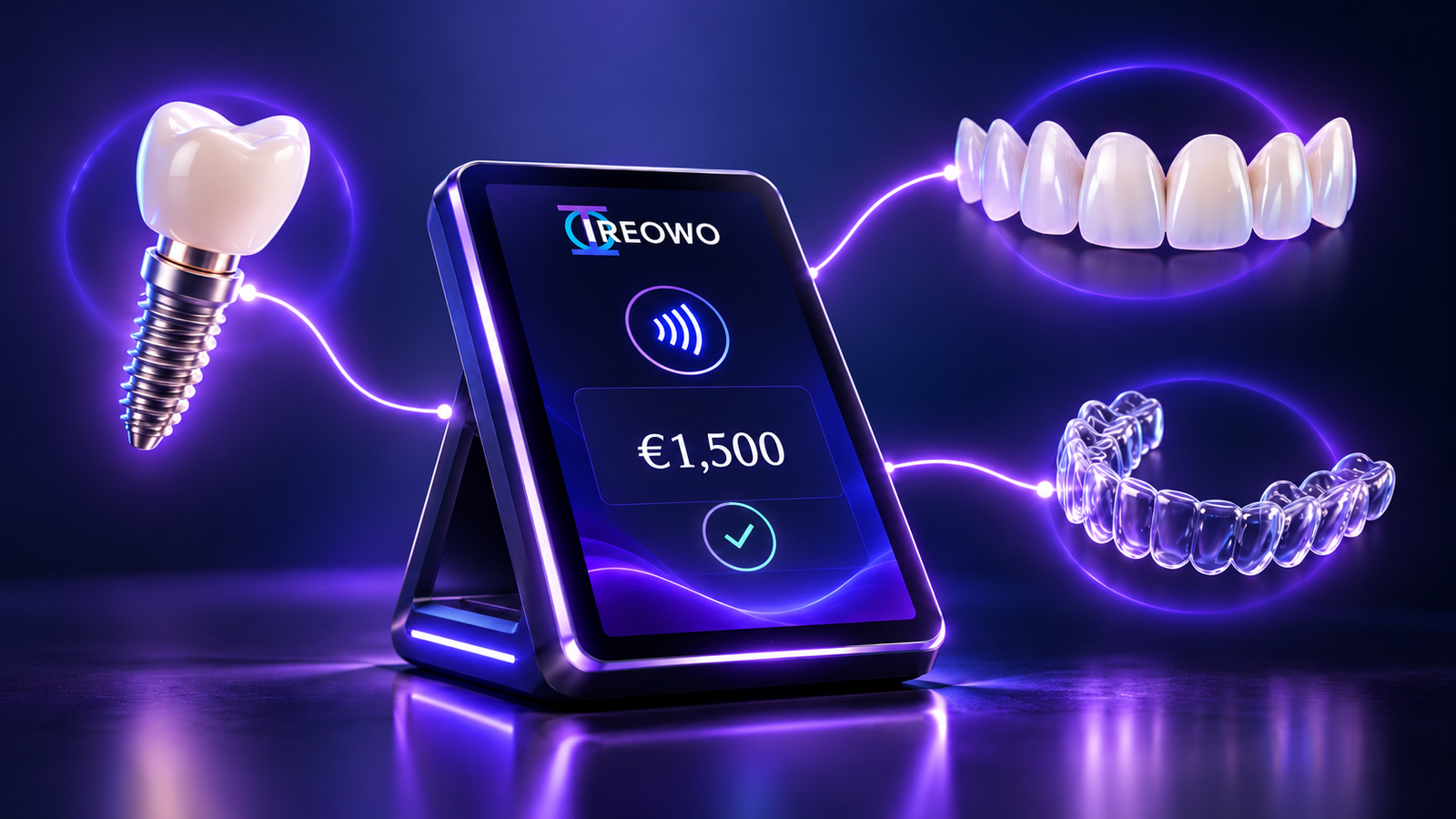
Dental practices frequently deal with treatment values that sit well above the average retail transaction. Implants, orthodontics, clear aligners, crowns, veneers, cosmetic dentistry and oral surgery can all involve payments considerably higher than those seen in a café, salon or shop.
This matters because a payment terminal for dentists needs to comfortably handle both ends of the scale, a routine check up payment on one visit, and a significantly larger payment for restorative or cosmetic work on another. A dental clinic payment terminal should feel just as straightforward for a £50 consultation as it does for a £5,000 treatment plan.
None of this means every dental practice needs identical infrastructure. The right setup depends on the mix of treatments a practice offers and how those payments are typically taken.
Every dental practice takes payments differently. If you would like to talk through a payment setup that fits your treatment mix, start your application with IREOWO. You pay nothing unless approved.
Taking Deposits Before Dental Appointments or Treatments
Many dental practices ask for a deposit before certain appointments or treatments go ahead. This is common for reserving a treatment date, securing an implant procedure, starting orthodontic treatment, or booking a longer specialist or cosmetic appointment.
A deposit gives a practice a clearer sense of appointment commitment, and can help manage any balance still owed once treatment is complete. From a payments perspective, the practice simply needs a reliable way to take that deposit and, later, the remaining balance, whether that happens in person or remotely.
Card Payments at Dental Reception
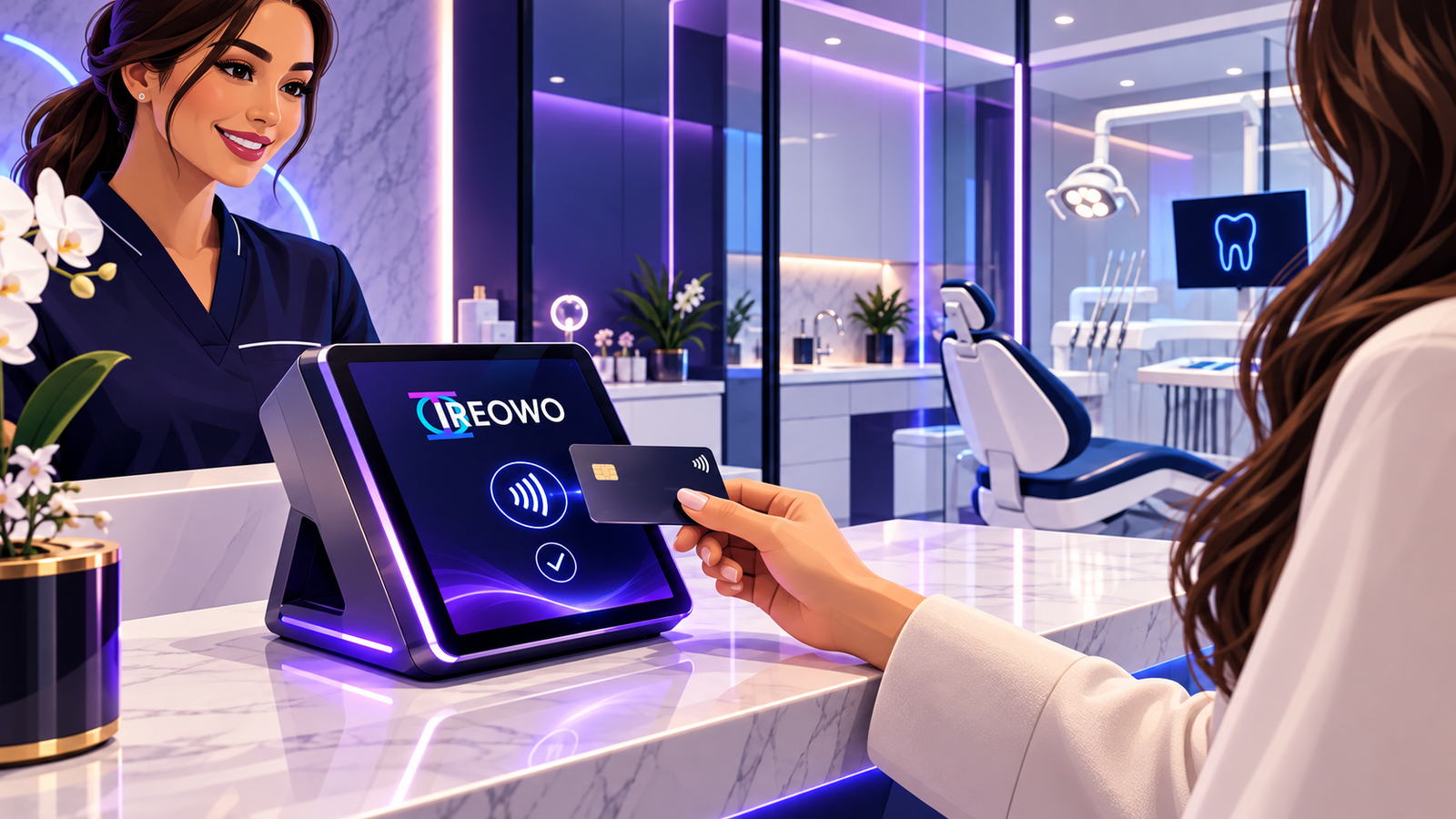
For most dental practices, the reception desk is where the majority of payments happen. A patient finishes treatment, walks to the front desk, and pays before leaving. This moment needs to be simple, both for the patient and for the reception team.
A countertop or touchscreen terminal at reception typically supports:
- Contactless payments
- Chip and PIN
- Digital wallets
- Fast checkout once treatment is finished
A dental practice card machine at reception should not slow down the end of an appointment. Patients are often keen to leave promptly, and reception staff benefit from a terminal that is quick to operate between patients.
Portable Card Machines for Dental Clinics
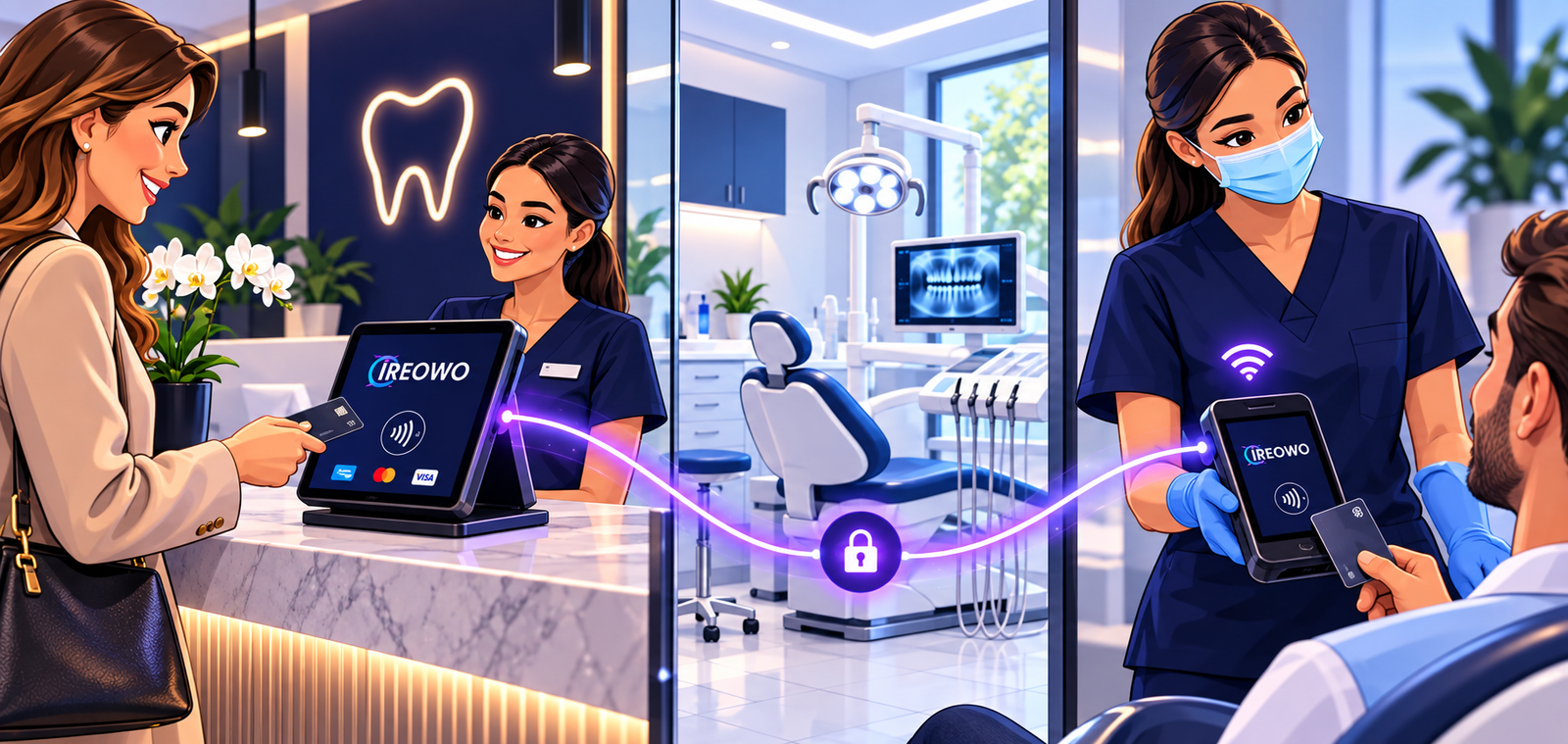
A fixed terminal at reception is not always enough. Larger clinics, practices with several treatment rooms, or clinics with private or VIP treatment areas often need to take payment somewhere other than the front desk. This is where a portable or wireless card payment machine for dentists becomes useful.
Portable terminals allow payment to be taken at the chairside, in a consultation room, or anywhere else in the building, without asking the patient to walk back to reception. For multi chair clinics, this can make the whole payment process feel more personal and less rushed.
| Dental Practice Setup | Suitable Payment Setup |
|---|---|
| Small dental practice | Countertop or portable terminal |
| Several treatment rooms | Portable terminal |
| Large dental clinic | Multiple terminals |
| Multi location dental group | Multi terminal payment setup |
These are general starting points rather than fixed rules. The right combination always depends on how a specific clinic is laid out and how patients move through it.
Payment Links for Dental Patients
Not every payment needs to happen in person. Secure payment links let dental clinics collect payment remotely, which suits deposits, outstanding balances, agreed treatment payments, payments taken before an appointment, or payments following a consultation.
With a payment link, the patient receives a secure link by message or email and completes payment from a phone or computer, at a time that suits them. This can be a helpful option for practices managing pre payment for treatment plans, or for patients who prefer not to handle payment during a busy visit.
If deposits and remote payments are part of how your practice works, IREOWO can help set up payment links alongside your terminal. Apply here, you pay nothing unless approved.
Accepting Visa, Mastercard, Apple Pay and Google Pay
Patients expect to be able to pay with the card or wallet they normally use. Support for Visa, Mastercard, contactless cards, Apple Pay and Google Pay is a common expectation at any modern dental reception.
Exactly which payment methods are available to a given practice depends on the acquiring and payment setup arranged for that merchant. Availability should always be confirmed as part of setting up a card payment machine for dentists, rather than assumed.
Card Machines for Dental Practices Across Europe
Dental practices accepting card payments are not limited to one country. Practices across the United Kingdom, Germany, France, the Netherlands, Belgium, Ireland, Italy, Spain, Portugal, Austria and other European markets all rely on dependable card acceptance.
Rather than country specific rules, what tends to vary between markets is acquiring availability, settlement timing, pricing and the exact payment options offered to a merchant. A practice operating in one country, or a group with clinics in several, should expect its payment setup to be shaped around its own country and business profile, rather than a single standard offer.
Dental Practice Payment Processing Costs
There is no single processing rate that applies to every dental practice. Pricing for dental payment solutions in the UK and Europe is shaped by several factors, including:
- Monthly card turnover
- Average transaction value
- Card type
- Domestic versus international cards
- Number of terminals in use
- Acquiring partner
- Payment method mix
- Settlement structure
- Business location
Because of this, a practice processing mostly small, everyday payments will typically have a different cost structure to a clinic handling frequent high value treatments. The aim here is simply to explain what shapes pricing, rather than to suggest a fixed rate that would apply to every practice.
Payment Solutions for Multi-Location Dental Groups
Dental groups running several clinics face a different set of questions to a single practice. With multiple terminals across different locations, it helps to have centralised payment management, so that reporting, reconciliation and oversight do not have to be handled separately for each site.
A consistent payment infrastructure across all locations, paired with reporting that covers the whole group rather than one clinic at a time, makes it easier for a growing dental business to keep track of its payment performance as it expands.
Why Dental Practices Work With IREOWO
IREOWO works with businesses to help them find a card acceptance and payment processing setup that fits how they actually operate, rather than a one size fits all package. For dental practices, that means taking into account the country a practice operates in, its payment volumes, average transaction value, number of locations, the payment channels it uses, day to day reception payments, deposits and remote links, and its overall business structure.
IREOWO is not a bank or card acquirer itself. Its role is to help dental practices and groups connect with suitable payment processing arrangements, based on how each business actually takes payment.
If your dental practice is ready to review its card payment setup, get in touch with IREOWO to discuss what fits your clinic. You pay nothing unless approved.
FAQ
Can dental practices accept high value card payments? +
Yes. Dental practices regularly take payments for implants, orthodontics, veneers and other treatments that are higher than typical retail transactions. A payment setup for a dental practice should be able to handle both routine and higher value payments comfortably.
Can dentists take deposits by card before treatment? +
Yes. Many dental practices take a card deposit to reserve a treatment date or secure a procedure such as an implant or a course of orthodontic treatment. This can be taken in person or, in many cases, remotely through a payment link.
Can dental practices accept Apple Pay and Google Pay? +
In most modern setups, yes. Support for Apple Pay and Google Pay alongside Visa and Mastercard is common at dental reception desks, though exact availability depends on the payment setup arranged for the practice.
Can a dental clinic use several card machines? +
Yes. Larger clinics with several treatment rooms, or dental groups with more than one location, often use several terminals, including portable options, so payment can be taken at reception or elsewhere in the practice.
Can dental practices send payment links to patients? +
Yes. Secure payment links let a practice collect deposits, outstanding balances or agreed treatment payments remotely, with the patient completing payment from their own phone or computer.