
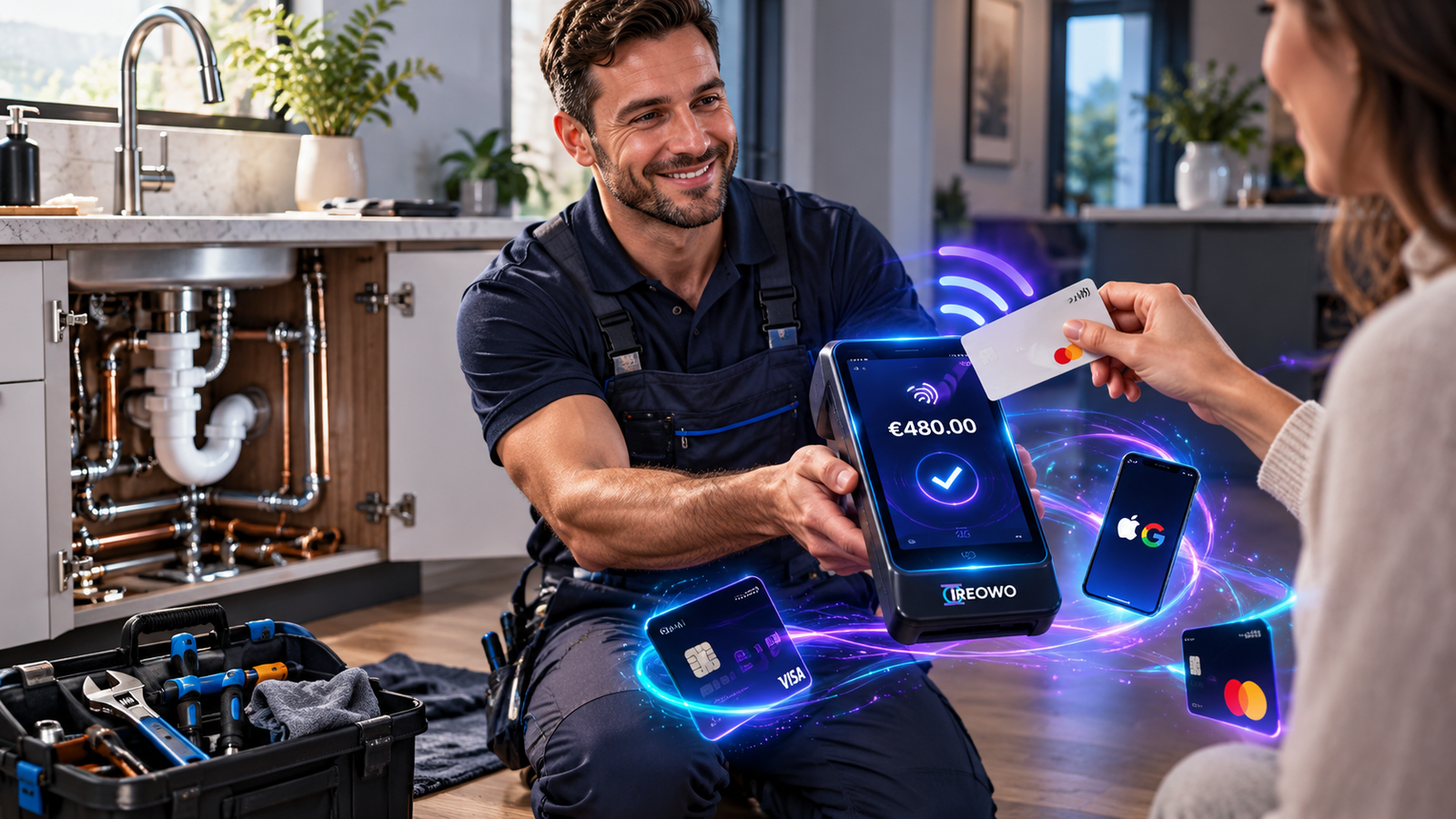
A boiler stops on a cold Sunday evening. The plumber arrives, finds the fault and fits a new part. The heat comes back on. Then the customer says there is no cash in the house. A bank transfer sounds like a job for tomorrow.
This happens all the time in plumbing. You work in kitchens, bathrooms and boiler rooms, not behind a shop counter. Bills can include call out fees, labour, parts and materials. A card machine for plumbers lets you get paid on the spot, when the customer is happiest.
This guide shows how a plumber card machine works in real life. We cover emergency call outs, deposits, teams and pricing.
Why Plumbers Need Reliable Card Payments
Most customers now expect to pay by card. Many keep no cash at home. Few want to hand notes to a stranger.
Card payments for plumbers solve several everyday problems:
- Payment happens at the customer's location, right after the job.
- You carry less cash in your van.
- Money arrives faster than chasing invoices by phone or email.
- Higher value invoices feel easier to pay by card.
- Evening and weekend call outs end with a simple payment.
You pay for parts on Monday. The customer pays "next week". Your cash flow suffers. Taking payment on site closes that gap.
Card Machines for Plumbing Jobs at the Customer's Location
For a plumber, the customer's home is the point of sale. So look first for a card reader for plumbers that you can carry.
At home and at commercial premises
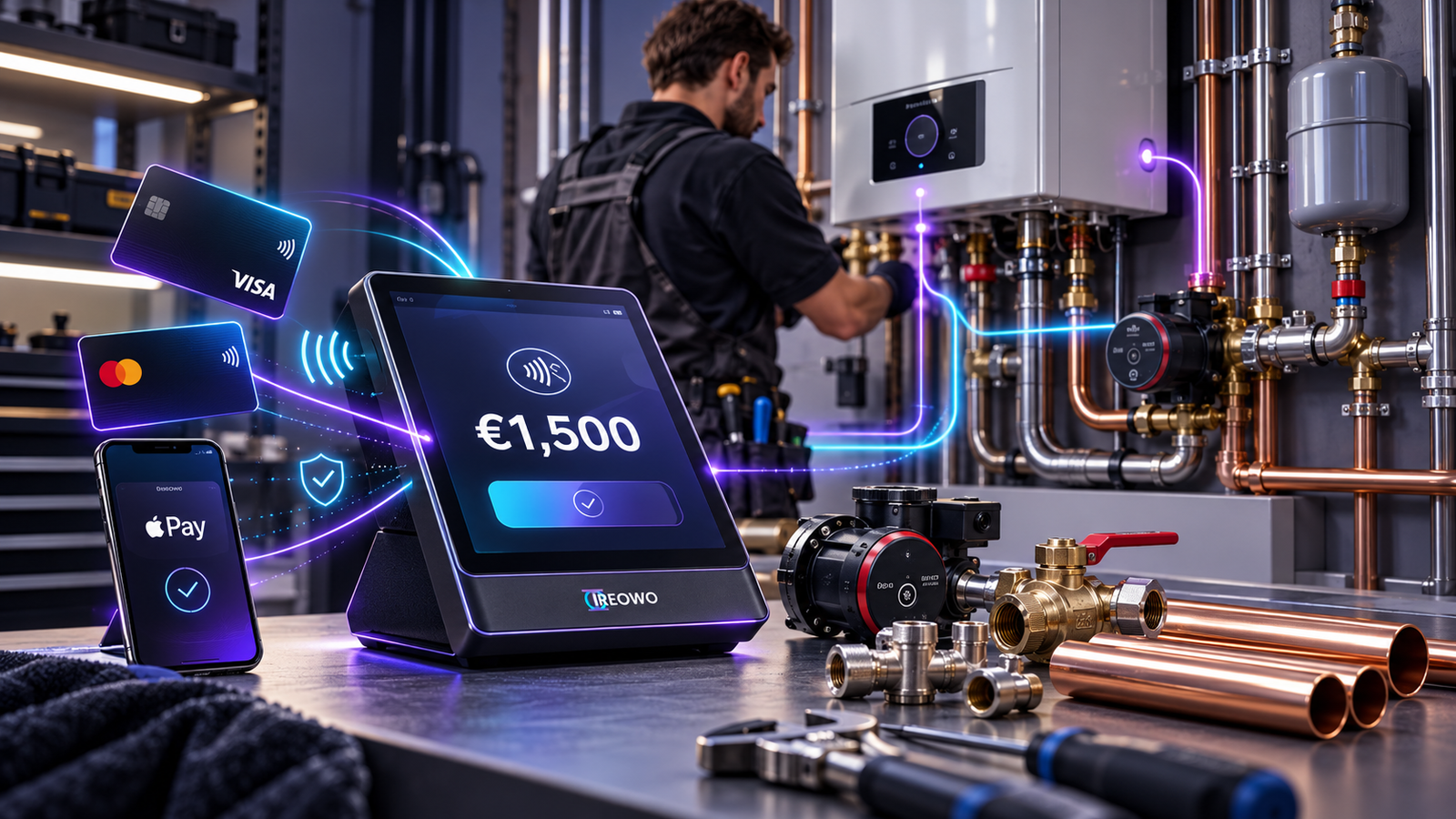
Picture a bathroom refit that ends at five. The plumber tests the taps and shows the work. Then comes the bill. The customer taps a card in the hall and the job is closed. Shops, bars and rental flats work the same way.
Confirmation, receipts and signal
A good terminal confirms payment at once. You know it went through before you drive off. Many also send receipts by email or text.
Signal matters too. Basements and plant rooms often have a weak one. A portable card terminal that uses mobile data, and WiFi where supported, gives you more than one way to stay online.
Want to know which terminal suits your van and your jobs? You can start a quick enquiry with Ireowo here. You pay nothing unless approved.
Mobile Card Machines for Emergency Plumbers
Emergency work is not planned work. The call comes at midnight. The customer is stressed. There is no office to go back to.
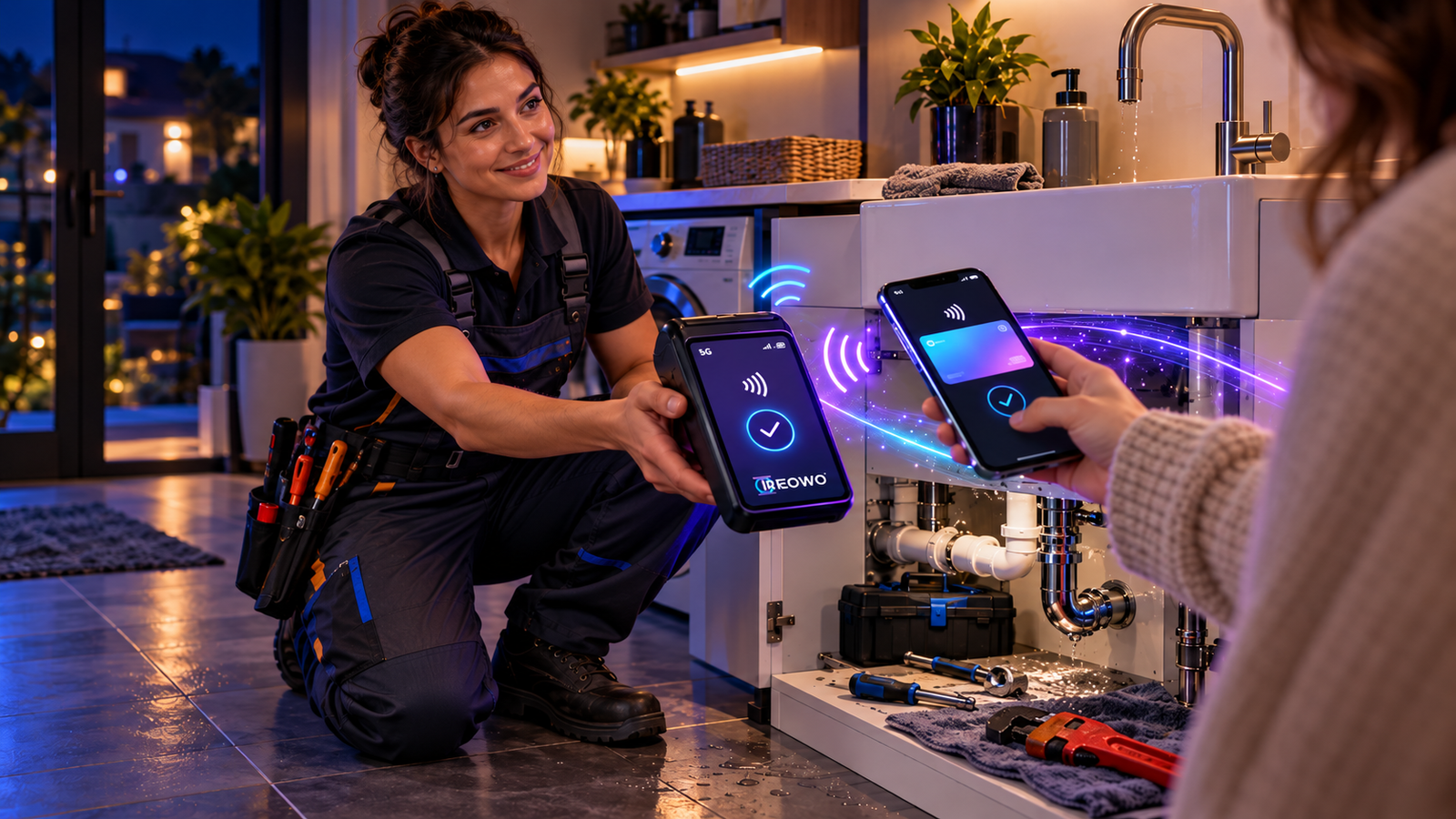
A mobile card machine for plumbers fits this well. You fix the burst pipe, explain the bill and take payment before you leave. The customer does not hunt for cash at 2 am. You do not chase an invoice the next day.
For late night jobs and weekend work, look for:
- A 4G or 5G signal, with WiFi where supported.
- A battery that lasts a full day of call outs.
- Contactless for quick jobs and chip and PIN for bigger repairs.
- Easy digital receipts.
Repairs often add costs, like a valve found behind a wall. A mobile POS for plumbers lets you update the total and take one payment at the end.
Taking Deposits for Plumbing Materials and Equipment
Some jobs need costly items ordered before work starts. A boiler, a pump, a water heater, special valves or fine bathroom fixtures can all mean a big upfront cost.
In those cases, some plumbing businesses ask for a deposit. It helps pay for the order. Deposits are a business choice, not a duty. Each plumber decides what suits them.
If you take one, say what it covers. Show the balance due on the quote. Send a receipt. Keep the record with the job.
Taking Payments for High Value Plumbing Jobs
Big jobs are where a good payment setup earns its place. Think of a new boiler, a full bathroom, a commercial heating repair or multi day work with parts and labour.
Customers want a payment method they trust for a big bill. Card present payments give clear, instant proof. You see the result on screen. The customer gets a receipt.
For multi day work, many plumbers agree stage payments. A portable terminal makes each stage easy to collect.
Fixed vs Portable POS Terminals for Plumbing Businesses
The right device depends on where payments actually happen.
| Terminal type. | Best for. | Typical plumbing use. |
|---|---|---|
| Fixed POS. | Office, trade counter, reception, plumbing showroom where applicable. | Customers who pay when they collect parts or visit your premises. |
| Portable POS. | Technician visits, homes, commercial properties. | Payment at job completion, on site. |
| Mobile POS. | Emergency plumbers and technicians who move between locations. | Call outs and quick repairs across different areas. |
Many firms use more than one. A fixed POS terminal for plumbing business counters handles walk in payments. Portable devices go out with the team.
Accepting Visa, Mastercard and Contactless Payments
Customers pay with the cards in their wallets. So most plumbers want to accept Visa and Mastercard, plus local schemes where the setup allows.
- Contactless: the customer taps a card or phone. It is fast and ideal for small repairs.
- Apple Pay and Google Pay: the customer pays with a phone or watch, where supported.
- EMV chip and PIN: the customer inserts the card and enters a PIN. A familiar choice for big bills.
Do not assume every terminal has every method. Check what your device and payment partner support.
Contactless is routine now. The European Central Bank reports 32.9 billion contactless card payments in the euro area in the second half of 2025.
Card Payments for Labour, Parts and Call Out Fees
A plumbing bill has several parts. A terminal can collect them in one payment. You never split the bill between cash and card.
Plumbers take card payments for many things. These include labour, call out fees, emergency fees and replacement parts. They also include installation, diagnostics, maintenance and repairs.
An itemised bill helps. The customer sees one line for the call out fee, one for the part and one for labour. They rarely question the total at the door.
Card Machines for Plumbing Companies With Multiple Technicians
Once several plumbers are on the road, payment becomes a system. You need to know who took which payment, for which job, and when.
A plumbing business POS for a team often includes:
- Several mobile terminals, one for each plumber or van.
- Payments by plumber, so every sale can be traced.
- One report and a clear view of payments for the office.
- One business wide payment setup.
This is where payment processing for plumbing companies differs from a one person firm. Multi terminal support depends on the payment partner, so ask early.
How Portable Terminals Help Plumbing Teams
When each plumber carries a terminal, payment happens when the job ends, not days later. That means fewer delays. It also means fewer calls from the office about who still owes what. Receipts reach the customer fast, and each sale is tracked against the job.
Battery power helps too. A portable card machine for plumbers can go from a loft to a boiler room to a van without a socket.
Managing Refunds, Cancellations and Plumbing Payment Disputes
Even good plumbing businesses get a refund request now and then. The best cover is a clear process from the first chat.
- Give a clear written quote before work starts.
- Describe the scope of work in plain words.
- Get the customer's approval before any extra work.
- Give an itemised bill and a receipt.
- Keep a simple refund policy that customers can read.
- Keep accurate transaction records for every job.
If a customer cancels after you order a part, a policy agreed in advance makes that talk easier. To learn more about card disputes, see our guide to chargebacks and friendly fraud.
Reducing Payment Disputes in Plumbing Businesses
Most disputes start with confusion, not bad intent. A customer sees a charge they did not expect. They ask their bank.
Match payment to invoice. The amount on the terminal should equal the bill. Send the receipt at once.
Record extra work. Found a rusty pipe or need an extra fitting? Explain it. Note the customer's approval. List the extra material costs.
Avoid duplicate charges. If a payment fails, check the terminal before you try again. That way the card is not charged twice.
Keep your records. Keep quotes, bills, receipts and photos of finished work together. You can also read about card scheme rules in our Visa and Mastercard rules guide.
Card Machine Features Plumbers Should Consider
You do not need every feature. Focus on what matters in a van or a boiler room:
- Size and battery life for a full day on the road, so your card terminal for plumbers keeps going.
- Mobile data and WiFi for steady use away from the office.
- Contactless and chip and PIN for quick and big payments.
- Reports, refunds and digital receipts..
- Multi terminal support if your team is growing.
The real test is the field. A terminal that works at the office but fails in a cellar is no help to a plumber.
How Much Does a Card Machine Cost for a Plumbing Business?
There is no single price. Every plumbing business processes payments differently.
The total has several parts. They are transaction fees, fixed transaction charges, monthly terminal fees, terminal rental or purchase, acquiring fees and chargeback fees where applicable.
Pricing depends on expected turnover, average transaction value, number of terminals, card mix, payment setup and payment partner. For more on how fees are built, read our guide to payment processing fees.
Ireowo values quality and stability, not just the lowest price. A cheap terminal that fails on a customer's doorstep costs more than it saves. See why the cheapest option can cost more.
Card Machines for Plumbers Across Europe and the UK
A plumber in Dublin, a heating firm in Munich and a boiler engineer in Lyon all want an easy way to get paid. The setup behind it can differ.
Payment setups vary by country, terminal provider, card needs, payment methods and the type of plumbing work. In Germany, local debit cards such as girocard are common. France uses Cartes Bancaires widely. Belgium has Bancontact. Plumbers in the UK, Spain, the Netherlands and Italy may see other habits.
In the UK, UK Finance reports that card payments made up 64% of all payments in 2025. If you work in more than one country, say so early. Availability depends on the payment setup and provider.
Why Work With Ireowo?
Ireowo helps plumbing businesses find suitable card machine and POS options. We look at your real working day, not a template. Together we can look at:
- Your payment needs and where you work.
- A card reader for plumbing company vans, a fixed terminal, or both.
- Your sales profile and number of plumbers.
- The payment methods your customers expect.
- More terminals as your team grows.
We value transparent payment processing, so you know what you pay for. The goal is a plumbing payment system that is simple for your plumbers and clear for your office.
Ready to take card payments on your next call out? Ireowo can help you find a payment setup that works in the van, at the customer's door and at the office.
You pay nothing unless approved.
Frequently Asked Questions
What is the best card machine for plumbers?
There is no single best option. The right card machine for plumbers depends on how you work. A plumber on emergency calls usually needs a small portable terminal with a mobile signal. A bigger firm may add one fixed terminal at the office. Check battery life, signal, reports and how many plumbers take payments.
Can plumbers accept card payments at a customer's home?
Yes. A portable card machine or mobile card reader lets a plumber take payment at the customer's home or shop when the job ends. The customer taps or inserts a card. Many terminals can send a digital receipt at once.
Can emergency plumbers use a mobile card machine?
Yes. A mobile card machine for plumbers suits emergency work. Call outs often happen at night, at weekends or far from the office. Look for a terminal with a 4G or 5G signal, or WiFi where supported. Then you do not need the customer's network.
Can plumbers take deposits by card?
Many plumbers ask for a deposit before they order boilers, pumps or water heaters. Card payments can be used for this, either in person or through other payment methods your setup supports. Deposits are a business choice, not a rule, so agree the terms with the customer in writing.
Can plumbing companies use multiple POS terminals?
Yes. Many setups allow several terminals for one business. This lets each technician take payment at the end of a job, while the office keeps a central view of transactions. Support depends on the payment partner and the equipment.
Can plumbers accept contactless payments?
Yes, if the terminal supports it. Most modern card terminals for plumbers take contactless cards. It is quick on a doorstep. Chip and PIN is still useful for larger invoices or when a customer prefers to insert their card.
Can plumbers accept Apple Pay and Google Pay?
Often yes. Apple Pay and Google Pay use contactless, so terminals that take contactless often take them too. Support can vary by terminal and payment setup, so check this before you choose a device.
How much does a card machine cost for a plumbing business?
The cost depends on your expected turnover, average transaction value, number of terminals, card mix, payment setup and payment partner. Costs can include transaction fees, monthly terminal fees, terminal rental or purchase, and chargeback fees where applicable. Ireowo can help you compare options for your own plumbing business.
Can Ireowo help plumbing businesses across Europe and the UK?
Yes. Ireowo helps plumbing businesses explore suitable card machine and POS options across Europe and the UK. We look at your payment needs, where you work, the type of terminal and the number of plumbers. Availability depends on the payment setup and provider.
Need a Card Machine for Your Plumbing Business?
Ireowo can help you explore suitable POS and card acceptance options for plumbers and plumbing companies across Europe and the UK.
Contact Ireowo to discuss your payment setup.
Take the next step and get your plumbing business ready for card payments.
You pay nothing unless approved.